5 Leadership Styles
 |
 |
 |
The 5 leadership styles described here were developed by Robert Blake and Jane Mouton, and is one of the most well-known leadership theories.
Known as The Managerial Grid, this theory describes five leadership types and focuses on two facets of the leader's attitude:
- Concern for people
- Concern for results
Leaders who lead focus on both: concern for people AND concern for results.
A visual representation of the Managerial Grid is shown below.
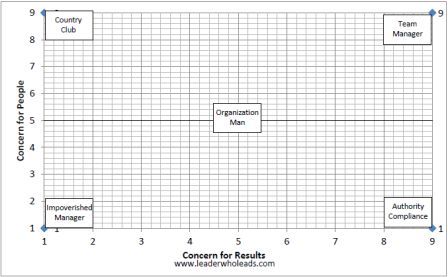
The 5 Leadership Styles
As you can see from the "grid" shown above, the five leadership styles are as follows:
- Organization (Wo)/Man
- Country Club
- Impoverished Manager
- Authority/Compliance
- Team Manager
The 5 styles reflects a combination of the two concerns: concern for people and concern for results. These two concerns run along a continuum (High to Low).
Concern For People
This quote by Theodore Roosevelt rings true, "People don't care how much you know until they know how much you care." So, as a leader, it is important that your employees and team members believe that you care about them as a person.
Doing so, greatly affects how you interact with them, and they with you.
Concern For Results
The hallmark of leaders who lead is their ability to get results. They are able to lead the charge in getting work done, especially as they lead others. Without results, no person, position or organization can survive and thrive.
Summary: The 5 Leadership Styles
Now, let's take a deeper look at the 5 leadership styles, which are a combination of concern for people and concern for results. They are:
- Organization (Wo)/Man
- Country Club
- Impoverished Manager
- Authority/Compliance
- Team Manager
#1 - Country Club
The Country Club style is a combination of the following:
High Concern For People + Low Concern For Results
The Country Club Manager gives thoughtful attention to the needs of their people, but it is taken to the extreme.
Working for a manager with this style may feel good in the moment; but at the end of the day, the inability to get results becomes problematic.
#2 - Impoverished Manager
The Impoverished Manager is a combination of the following:
Low Concern For People + Low Concern For Results
Have you ever reported to an impoverished manager, one who does just enough to get by? This style is also referred to as a laissez-faire leader, which means this type of leader goes with the flow, avoids conflict and lays low.
#3 - Organization (Wo)/Man
The Organization (Wo)/Man is a combination of the following:
Medium Concern For People + Medium Concern For Results
#4 - Authority/Compliance
Authority/Compliance is a combination of the following:
Low Concern For People + High Concern For Results
Efficiency is the keynote of this manager, even when it hinders effectiveness. In their minds, they are synonymous. Some people feel like a "human doing" not a "human being" when working for a manager with this style.
#5 - Team Manager
Team Manager is a combination of the following:
High Concern For People + High Concern For Results
The Team Manager style combines "optimal" concern for people with "optimal" concern for results.
Leaders with this style get their people to work with them to achieve mutually beneficial goals.
Summary
Of the 5 leadership styles, aspire to be a Team Manager. It balances both the concern for people and the concern for results. This is the stuff leaders who lead are made of!
Virtual (Online) Learning Opportunity
 |
Join me for a focused conversation designed to offer a clear roadmap for what to do when a leadership position finds you—whether you pursued it or it found you.
This session creates space for reflection, real‑world application, and honest dialogue about what it takes to lead with clarity, courage, and confidence.
Whether you’re stepping into leadership for the first time or strengthening your existing leadership muscles, this Lunch & Learn will meet you where you are and help you become the leader you were called to be.
Want to join the waitlist? Do so below.
Bonus Gift
Improve Your Relationship with Your Boss
Did you choose your boss, or did your boss choose you?
Either way, strengthening that relationship is always a smart move.
Wouldn’t you agree?
If so, the Boss Relationship Worksheet is a practical tool designed to help you:
- Communicate more effectively,
- Understand your supervisor’s expectations, and
- Build a healthier, more productive working partnership.
Clarity with your boss starts here.
Share your information in the form below, and your download will be on its way.
Strong leadership starts with knowing how to work well with the person you report to.
After completing the Boss Relationship Worksheet, take a look at the information below. It will prove helpful in showing you how to cultivate a better working relationship with your boss: